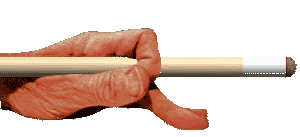
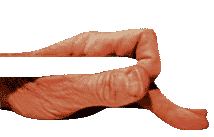
"In building cues, Stroud says, "you have to understand the mentality of the pool player. You get attached to vour stick. I literally slept with mine. It went into the bathroom with me when I went to the bathroom." Any-thing on the stick that would interrupt the shooter's concentration must be eliminated, especially visual distractions on the shaft. "I'd like to have a piece of ash that grows perfectly straight and clear." Stroud savs wistfully, "but it doesn't grow that way." Instead, therefore. he uses Canadian maple for his shafts. He is meticulous about the taper, or lack of taper. he gives them. A good pool cue, he says, comes straight back for at least the first ten inches so it won't cause your fingers to spread as it glides through vour bridge on the stroke, throwing off vour arm and shattering your concentration.
"The best cues are made out of wood that's totally relaxed. If the tree grows on a hillside, it'll grow at a different rate on each slide and that creates a lot of tension. A lot of cue makers don't have a chance to let their cues sit around and relax. The essence of a good cue, to me, the primary thing, is the way it plays. Some cues feel lively, some cues feel dead, like you're plaving with an inert piece of material. I remember once, in Johnson City, some guy brought out a fiberglass cue. It seemed like a fabulous concept-but you couldn't move the cue ball with it."When work is a problem, he plays golfStroud has experimented with materials like graphite and boron fiber, but currently makes his cue sticks only from wood, investing about 25 hours of work in each one. "There are hundreds of separate steps," he savs. He works in dailv increments, striving always toward a perfect cue, finding each component task every bit as absorbing and intense as playing at the pool table. Whenever the work becomes a problem, he says. he breaks and goes off to play golf.
"First," Stroud savs, "you have to rip the lumber. Then it has to be cut to length. Then it is turned." Stroud uses a $27,000 wood-and-metal-turning lathe to work his shafts into shape because it affords greater control over the cutting than most woodworking lathes. He spins the shafts at the excruciatingly slow speed of 300 rpm, taking off only a minute ten-thousandth of an inch at each pass to keep vibration to a minimum and thus maximize the symmetry of the shafts. "If they aren't suitable, into the trash. I let my shafts sit a week, then I'll put them back on and taper them five or six more times." After everv session of turning, he seals the shaft's newly raw surface, "to slow down the atmosphere getting to the material." Then, says Stroud, "I let it rest, let it sit as long as I can. You can see the personality of each piece of wood, how you want to utilize it. The wood will tell you what to do with it, if you give it a chance.
"Stroud makes the ferrules for his sticks out of old ivory, fits them to the shafts, faces them, then glues on the leather tips. "I use French 'Champion' tips, over 15 years old, that have been carefully selected and stored. I bought them from a tip fanatic in Evansville, Indiana. One old man in France made these tips, and he taught his son and the qualltv went down. When the Vietnam War started, the leather for these, water buffalo, disappeared. The hide has to be about two inches thick when vou start. I have five boxes of fifty, paid $5 for each tip.
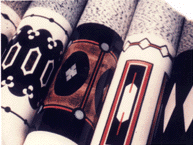 Meanwhile,Stroud says, "I've been working on the butt, begun the process of making the parts for the inlay from the design worked out on the Macintosh, assembled the background pieces, weighed all of those on a gram scale." The red is colored French maple, the black is ebony, the white is ivory, elephant tusk. "All the ivory I use was taken before I was born," says Stroud. "I'm a member of Greenpeace, and I'm concerned about preserving the elephants; I think they belong on the endangered species list. 1 think ivory looks better on the elephant than it does on ladies' hands or a pool cue.
At this particular stage,I look at mv chart and if it savs 375 grams, then, when I'm finished, I know I'll have a 19 1/2-ounce cue. The computer creates a discipline I didn't have before. Then I assemble it, put the butt plate on, put the cue back in the machine and turn it a few times. The longer I let it sit, the more I like it. I usually let it sit for two months. Then I put the joint in, and I meld the shaft and the butt together.
"Eventually I fit the wrap to it," heavy Irish-linen threads tightly wound around the gripping area. "I hand-sand the cue to where it's as smooth as glass, using 1500-grit sandpaper; most auto finishers use 500-grit, one-third as fine. I coat it with the same polyurethane used on race cars, which costs $50 a gallon.
"Several times a week, Stroud takes a finished cue to the post office for shipment to a waiting customer. "And," he says, "vou see them again from time to time." Once. Stroud recalls, after a customer broke his stick for the fourth time. he and partner Danny Janes took a Louisville Slugger baseball bat, turned it down a bit on a lathe, so the handle of the bat would accept a joint, fitted a shaft and shipped it off -with a bill for $500. Janes now makes his top-quality sticks as Joss Cues Ltd. in Baltimore, while Stroud, in Colorado Springs, makes his as Joss Cues West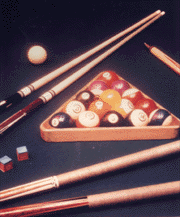
.Bill Stroud, who says he quit college after a couple of years because "I learned what college graduates were making and it never seemed reasonable to me -- I was making $500 a week at pool when I was 16," now has a showplace home full of steel-and-leather furniture by artists like Mies and Le Corbusier and Eames, a red Mercedes 560SL in the garage, a black 16-valve Mercedes 190E for Barbara, in the driveway, and a snappy red Mitsubishi Montero they use to haul gardening supplies and wood. When Stroud needs to know the time, he can flick his cuff back and glance at his Rolex Submariner or his gold Rolex President.
But he yearns for more. "I overindulge," he says. "When you grow up without anything -- I'm getting over it." Still, he now wishes he could push his cue making even further, until he achieves display by a gallery as well as by the hands of billiard and pool professionals."On the edge," Bill Stroud says, "that's where I want to be. In the middle, that's terminal."